
Istanbul Nişantaşı University Among the World’s Top 1,000 Universities in the THE World University Rankings
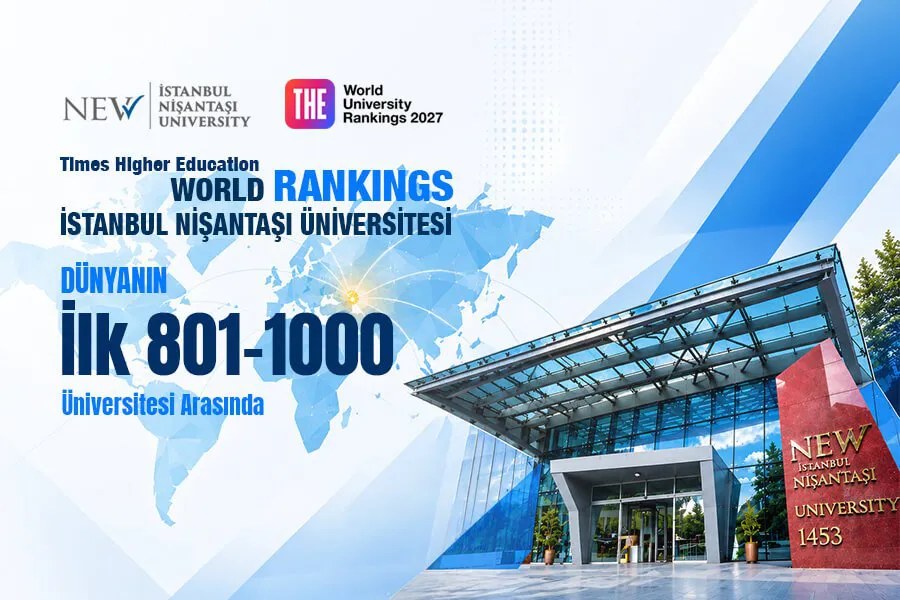
Istanbul Nişantaşı University ranked in the 801–1000 band of the THE World University Rankings 2027. It placed first in Türkiye for research quality and second for international outlook.
Istanbul Nişantaşı University has been placed in the 801–1000 band in the 2027 World University Rankings announced by Times Higher Education (THE), one of the world’s leading higher education ranking organizations. Thirteen universities from Türkiye are among the top 1,000: seven public and six foundation universities. We congratulate Koç University, Middle East Technical University (METU), Sabancı University, Boğaziçi University, Bilkent University, Istanbul Technical University (ITU), Abdullah Gül University, Atatürk University, Hacettepe University, İstinye University, Özyeğin University and Yıldız Technical University, which join Istanbul Nişantaşı University in the top 1,000.
Commenting on the university’s achievement, Istanbul Nişantaşı University Founding President Levent Uysal stated that the result was an important reflection of the educational vision and long-term investments the university has pursued since its establishment.
Uysal said: “When we founded Istanbul Nişantaşı University, our foremost goal was to create a university that offered young people world-class educational opportunities, advanced through science and technology, and built strong ties with the international academic community. Being among the world’s top 1,000 universities today is a highly valuable outcome of the investments we have made over the years in line with this vision. We continue to invest in our academic staff, research infrastructure, technology and our students’ future. Every international achievement of our university motivates us to provide greater opportunities for our young people and contribute more to our country’s scientific and technological development. We have much greater goals ahead, and we are working towards them with a strong team and a shared conviction.”
First in Türkiye for Research Quality
The THE World University Rankings assess universities across five key pillars: teaching, research environment, research quality, industry and international outlook.
Istanbul Nişantaşı University’s strongest performance in the 2027 results was in research quality. The university scored 76.9 in this pillar, which accounts for 30 percent of the overall ranking score, and ranked 430th worldwide.
The result in this pillar, which evaluates indicators such as citation impact, research strength, research excellence and research influence, is an important measure of the quality of Istanbul Nişantaşı University’s scientific output and its impact on the international scientific community.
The university also ranked 419th worldwide for international outlook, which assesses the proportions of international students and staff, as well as international co-authored publications.
Istanbul Nişantaşı University Rector Prof. Dr. Ayşegül Komsuoğlu stated that the results offered an opportunity to assess different aspects of the university’s academic development strategy together.
In her assessment, Komsuoğlu Çıtıpıtıoğlu said:
“International university rankings are important tools that enable higher education institutions to evaluate their performance in education, research and internationalization using common indicators. The five key pillars of the THE World University Rankings—teaching, research environment, research quality, industry and international outlook—allow universities to analyze their academic capacity comprehensively.
Being among the world’s top 1,000 universities is an important milestone for us. Ranking first in Türkiye for research quality and second for international outlook is a highly valuable outcome of our work in research and internationalization in recent years.
We regard these indicators as an important part of our institutional development strategy. Aligning academic staffing with student capacity, extending research productivity across the institution, strengthening the scientific impact of our publications, international collaborative research and industry-supported scientific output are among our priority areas.
Our strong result in research quality provides significant motivation. In the coming period, we aim to extend this scientific impact to a broader base of researchers and further develop strong research teams, interdisciplinary work, access to national and international funding, and our students’ participation in research.
Our international outlook result is also highly valuable in strengthening the academic dimension of our approach to internationalization. We attach importance to turning our international collaborations into joint research, co-authored publications, researcher mobility and new academic opportunities for our students.
Teaching, the research environment and especially university–industry collaboration will also be major focus areas of our development strategy in the coming period. We aim to improve our industry-supported research capacity, applied education models and mechanisms that help transform scientific knowledge into economic and social value. We see this result as an indicator of the academic capacity we have achieved and a strong starting point for our future development.
We extend our sincere thanks to all our academic and administrative staff. Today’s success is the result of collective wisdom, diverse perspectives and systematic work. Each of you has contributed your efforts, ideas and lasting influence to this institution.”
Holistic Development in Education and Research
Istanbul Nişantaşı University regards the joint development of educational and research capacity as a fundamental element of its institutional strategy. Strengthening academic staff, improving research infrastructure and expanding students’ access to high-quality educational and research opportunities are the main components of this approach.
Alignment between student numbers, academic staff, research infrastructure and applied education opportunities plays an important role in the university’s approach to sustainable development. Developing doctoral education alongside strong research areas and extending scientific output across all academic units are also among its long-term academic goals.
The university views educational quality and research performance as parts of an academic ecosystem that reinforce one another. This understanding also supports students’ earlier engagement with research during their studies and the stronger integration of academic knowledge into their educational experience.
From Research Culture to Scientific Impact
Achieving first place in Türkiye for research quality also provides an important reference point for the university’s research strategy in the coming period.
Istanbul Nişantaşı University places the spread of research culture across all academic units, the formation of strong research teams, continuity in scientific output and greater international scientific impact among its institutional priorities.
Academics from different faculties and disciplines are encouraged to come together in shared research areas, develop interdisciplinary projects and participate more actively in international scientific networks. Strengthening priority research areas, increasing access to national and international funding and improving support mechanisms for researchers also occupy an important place in the university’s research strategy.
The aim is to improve the quality and impact of scientific output while taking into account the distinctive research dynamics of disciplines ranging from health sciences to engineering and from social sciences to art and design.
Students as Part of the Research Ecosystem
Students’ early participation in scientific knowledge production has a special place in Istanbul Nişantaşı University’s approach to research.
The university is developing models that help students become familiar with scientific research methods, work on projects alongside academics, interact with international researchers and gain research experience.
The student research program developed under the mentorship of researchers affiliated with Harvard Medical School and Brigham and Women’s Hospital is one concrete example of this approach. The program aims to enable students to experience an international research culture, participate actively in scientific work and gain the skills needed to present their research findings in international academic settings.
The university regards early involvement in the research ecosystem as an important academic benefit for the development of analytical thinking, scientific curiosity, problem-solving and research skills.
Second in Türkiye for International Outlook
International outlook was another area in which Istanbul Nişantaşı University stood out in the THE 2027 results. With a score of 72.2, the university ranked second in Türkiye and 419th worldwide in this pillar.
The university’s internationalization strategy is built on developing international collaborative scientific output, strengthening research partnerships and providing students with global academic experiences, alongside diversity among international students and academic staff.
Turning relationships with universities in different countries into joint research projects, scientific publications, student and staff mobility, and joint education models forms the basis of this approach.
Activities carried out under NEV Global support students’ access to exchange programs, summer schools, short-term international programs and varied academic experiences. They also aim to help academics participate more actively in international research networks and strengthen capacity for joint scientific output.
From Research to Innovation Through University–Industry Collaboration
Industry indicators, one of the key pillars of the THE methodology, also reveal the relationship between universities’ research capacity, industry and the creation of economic value.
Istanbul Nişantaşı University regards university–industry collaboration as a priority area for development in the coming period.
The university’s approach to applied education supports students’ engagement with current technologies, industry practices and real working environments. Partnerships with leading institutions and companies in Türkiye and around the world aim to expand applied education opportunities, strengthen research infrastructure, develop new educational modules and support joint scientific work.
These collaborations also support the university’s existing 7+1, 6+2 and 3+1 models for long-term workplace experience and internships.
Increasing industry-supported research projects and research income, helping scientific knowledge become innovative applications, strengthening employers’ involvement in educational and project processes, and expanding partnerships that support graduates’ career development are among the university’s main areas of work for the coming period.
In line with this approach, Istanbul Nişantaşı University aims to develop a holistic ecosystem that extends from education to research, from research to innovation, and from innovation to social and economic value.
Quality Assurance and Strong Institutional Governance
Quality assurance, data-driven management and institutional governance play an important role in Istanbul Nişantaşı University’s development within international higher education.
The university’s institutional accreditation by the Turkish Higher Education Quality Council in 2026 was a significant achievement in its quality assurance work.
Extending continuous improvement across the institution in education, research, societal contribution and governance supports the university’s strategic development goals. Processes ranging from academic workforce planning and research investments to student support mechanisms and international collaboration are considered within a shared strategic framework.
Monitoring institutional performance using reliable data, regularly evaluating academic indicators and reflecting the results in decision-making are also fundamental components of its management approach.
Considering YÖKAK institutional accreditation together with data from international ranking systems such as THE helps the university monitor its academic development from different perspectives and shape new goals on the basis of evidence.
From the Top 1,000 to New Academic Goals
The university aims to sustainably enhance its scientific impact in research quality, extend this impact to a broader base of researchers, deepen international academic collaboration, strengthen the teaching and research environment, and expand university–industry partnerships through new research and innovation models.
With the international visibility gained by being among the world’s top 1,000 universities, Istanbul Nişantaşı University will continue to improve the educational and research opportunities it offers students, increase the international impact of its scientific output and contribute to Türkiye’s visibility within the global higher education and research ecosystem.